The Digi Change Project is Transforming Education: The Department of Biophysics, Medical Equipment and Informatics Presented Simulation Technologies and the Use of AI in Medical Training
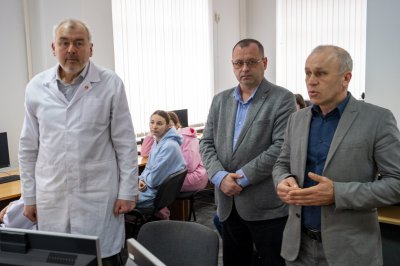
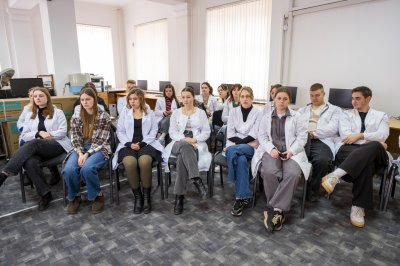
A special lecture dedicated to the ethics of using artificial intelligence (AI) in education was held on March 18 for first-year students of the Medical and Pharmaceutical Faculties. It began with a presentation of a simulator — an original development of the Department of Biophysics, Medical Equipment and Informatics at National Pirogov Memorial Medical University, Vinnytsya (VNMU).
The system was created for training 4th- and 5th-year students mastering the specialty of gynecology. It simulates the process of examining and treating a pregnant patient: collecting medical history, physical examination, hardware monitoring, and simulation of medication administration. At several stages, the student fills out test forms, and at the end receives an overall assessment.
This system will become a modern addition to the educational process and one of the proofs of the successful implementation of the ERASMUS+ Digi-CHange project at VNMU. The project aims at the wide integration of modern digital technologies into educational components. The effective digitalization of the learning process confirms VNMU’s leadership in the Digi-CHange project, as our university serves as the national coordinator of the project in Ukraine.
The developer of the simulator, Associate Professor Oleksandr Nikolskyi, explained that several artificial intelligence models were used to create the expert system. In particular, Gemini helped prepare a training dataset of 100 real clinical scenarios.
The development also incorporated feedback and suggestions from students. According to Acting Head of the Department Volodymyr Didych, while working within the elective course “Artificial Intelligence for Pharmacists,” students gain practical skills in interacting with various machine intelligence systems, understand their capabilities and limitations — and this empirical experience is valuable for creating educational programs.
The event continued with a practical session titled “Artificial Intelligence in Medicine and Pharmacy,” focused on the ethical aspects of using AI in medical education. Students and lecturers discussed where the line lies between an AI assistant and the replacement of human expertise. As Associate Professor Oleksandr Ivanovych noted, “Artificial intelligence is not a replacement for human intelligence, but its extension. However, in medicine, an algorithmic error costs significantly more than in other fields.”
The main ethical principle is “Do No Harm.” AI should serve as a technology and tool to expand capabilities, but not as a substitute for clinical thinking. The consequences of the latter approach include the loss of a doctor’s ability to diagnose and make decisions independently, as well as the erosion of a humane attitude toward the patient.
The main ethical risks and challenges include:
- Responsibility for human health and life — in case of an algorithmic error and harm to the patient, the doctor bears the liability;
- Dependence on AI reduces basic professional training and leads to the loss (or failure to acquire) of professional competencies;
- Loss of empathy;
- Using AI for quick answers creates an illusion of knowledge but kills research skills;
- Loss of ability to work independently with medical knowledge databases;
- The so-called “filter bubble”: AI tends to ignore rare clinical cases or contradictory data, so the researcher does not receive comprehensive information;
- Atrophy of critical thinking;
- Violation of academic integrity principles, including hidden plagiarism.
On the other hand, the advantages of using artificial intelligence in scientific research include the ability to generate and formulate new ideas, efficient search for relevant sources, rapid processing of large volumes of information, creation of visual materials, and assistance with text checking and translation.
Oleksandr Ivanovych paid special attention to the issue of data confidentiality breaches and the risks of deanonymization. He explained in detail to the students how to use synthetic data when working with AI.
Time flew by unnoticed. Both the presentation and the lecture were well received by the audience. There were many questions, lively discussions, and exchanges of opinions. As for the new simulator, according to Volodymyr Didych, it will soon be implemented into the educational process. Additionally, a similar system is currently being developed by the department’s specialists for training future therapists.
VNMU Media Center